Showing posts with label tobey. Show all posts

Saturday, March 26, 2016

game preview: Syracuse


Date/Time: Sunday, March 27; 6:09

TV: TBS

Record against the Orange: 4-3

Last meeting: UVA 73, SU 65; 1/24/16, Charlottesville

Last game: UVA 84, ISU 71 (3/25); SU 63, GU 60 (3/25)

KenPom:

Tempo:
UVA: 61.6 (#351)
SU: 65.3 (#324)

Offense:
UVA: 119.2 (#8)
SU: 110.7 (#53)

Defense:
UVA: 91.5 (#4)
SU: 94.8 (#19)

Pythag:
UVA: .9544 (#1)
SU: .8560 (#28)

Projected lineups:

Virginia:

PG: London Perrantes (10.8 ppg, 3.0 rpg, 4.5 apg)
SG: Malcolm Brogdon (18.4 ppg, 4.0 rpg, 3.0 apg)
SG: Devon Hall (4.4 ppg, 2.6 rpg, 1.9 apg)
SF: Isaiah Wilkins (4.8 ppg, 4.1 rpg, 1.4 apg)
PF: Anthony Gill (13.9 ppg, 6.2 rpg, 0.8 apg)

Syracuse:

PG: Trevor Cooney (12.8 ppg, 2.5 rpg, 2.3 apg)
SG: Malachi Richardson (13.0 ppg, 4.2 rpg, 2.2 apg)
SF: Michael Gbinije (17.8 ppg, 4.1 rpg, 4.3 apg)
SF: Tyler Lydon (10.2 ppg, 6.3 rpg, 1.2 apg)
PF: Tyler Roberson (9.0 ppg, 8.5 rpg, 1.4 apg)

The first five S16 games went by with minimum suspense.  That included UVA, which toyed with the idea of blowing the Iowa State game on a couple occasions but dismissed the idea each time.  UNC was always going to roll Indiana, so that left ND-Wiscy and SU-GU to try and inject a little drama into the proceedings.  They didn't disappoint.  Syracuse spent most of their game looking destined to fall a little short, until the fact that Gonzaga only played six guys caught up to them, and the Cuse snatched up the trip to the E8.  ND did the same thing to Wisconsin, and now the ACC is guaranteed two slots in the Final Four - no more, and no fewer.

For UVA, it means a familiar opponent in a game for the right to put up a banner.  Syracuse's inclusion in the tournament elicited a "WUT" from a CBS talkinghead during the Selection Show upon announcement, and now they're halfway to the big prize.  They've taken a slightly nontraditional route.  Having been the direct beneficiary of possibly the biggest upset in tourney history is lucky but irrelevant - it still means they took care of business when other teams didn't.

The last time these two teams played, it was a closer UVA win than the score indicated, but UVA was scratching its way out of an early-season hole and the chemistry experiment was only just falling into place.  Syracuse ended the year on a 1-5 low note, but three straight wins have erased those memories.  This time of year, everyone who's left is riding high.

-- UVA on offense

All about that 2-3 zone.  Probably no defensive scheme is so well-associated with one team as the Syracuse 2-3 zone.  It can be tough to attack because it's so packed-in, but UVA's familiarity with it can only help.

Like Iowa State, Syracuse is a thin team.  Five starters who play 30+ minutes, and two bench guys, and that's it.  And like Iowa State, this necessitates a minimum of fouling, though the zone and a slow tempo help in that regard.  Syracuse is good at keeping out of foul trouble, with heavy assistance of the above two factors.  They're also "good at free throw defense" - because it's so hard to drive against the zone, most of their fouls are committed on big men.

There are two primary ways to attack the zone: Shoot over top of it, or try to catch them over-rotating and get to the middle near the free-throw line.  UVA used both to good effect in their last win, with 44.4% three-point shooting and 7-for-11 shooting from Anthony Gill.  Gill is a tremendous weapon against the 2-3 because he's at his best when he can face the bucket with a little room, and bull-rush the hoop.  When he gets the ball just under the free-throw line, he's one dribble from the bucket and almost unstoppable.  This is easy to do against the 2-3 because of where the defenders are positioned, especially if the center has been caught on one side of the lane.

Another defining characteristic of the zone is its propensity to give up offensive rebounds.  Players in a zone aren't tracking a particular player, so boxing out is complicated.  Getting in position to do so usually means abandoning your zone.  Over the years, Syracuse's defensive rebounding has ranged from kind of bad to completely horrible.  It's at the latter end of the spectrum this year.  UVA only got four offensive boards in the regular-season game against Cuse, but Mike Tobey has been on a mission lately and recently destroyed ISU, Butler, and Miami on the offensive glass.

And there will be a role for Tobey.  A very big one.  Neither Tyler Roberson or DaJuan Coleman range far from the rim, so Tony will feel free to use Tobey without a concern for matchup problems.  Syracuse doesn't fast-break much and they need to collapse hard on the glass to rebound, so the new Rampage version of Mike Tobey we've seen in postseason play could be in for yet another big game, mucking it up on the offensive glass.  Even in the loss, Gonzaga's Domantas Sabonis was a complete wrecking ball, with 19 points and 17 boards.  Using Tobey to bludgeon Cuse into submission will go a long way.

-- UVA on defense

Last time we met, on the JPJ hardwood, Cuse kept things close because Michael Gbinije and Malachi Richardson went absolutely nuts from three, combining to shoot 11-for-19 from deep.  It's really been only since then that Malcolm Brogdon went ham on the defensive end, and his work on Gbinije this time around will be critical.

I think it's safe to guess that'll be the matchup.  Trevor Cooney is nominally the point guard, but Gbinije has taken over the primary ballhandling role as more of a point forward.  He'll take any shot on the court, and is a tremendously adept passer.  He'll also play almost every minute and make his defender work hard for all of them, so it won't be 100% Malcolm, but still.

Syracuse has a bit of a love affair with shooting the three - 42.5% of their shots are from deep.  That said, only four of their seven guys will ever shoot one.  Gbinije and Tyler Lydon are reasonably dangerous 40% shooters; Cooney and Richardson can get hot but are about average overall.  (Cooney in particular has never been the least bit shy to let them fly, and can look alternately like J.J. Redick or a no-thought brickheaver at any given moment.)

Inside the arc, though, Syracuse is a below-average team.  Cooney and Richardson are both sub-40% shooters from two, and Cuse doesn't have anyone above 60%.  The last time UVA faced a team without a guy shooting 60% from two was the NC State game.  They shot more threes than twos in our last game and kept it close only because of those threes from Richardson and Gbinije.

There's plenty of talent on this team, and they go six deep with high-quality basketball players.  (Franklin Howard is the seventh rotation guy, and he scares nobody.)  And Cuse put up a hell of a fight against Gonzaga and saw their efforts pay off.  They scrapped impressively hard.  But - and you knew this paragraph would have a But - neither do they have anyone who UVA hasn't already figured out how to stop.  There's no Georges Niang running around.  There might not even be an Andrew Chrabascz.  Syracuse's game plan will be to fling away from three and hope they go down.  They might, and that would be a fairly big problem.  But there isn't much other alternative.

-- Outlook

I hate what I'm about to do.  Getting too cocky at this time of year has a way of making you look like an ass, and yes I know I'm not the one on the court but that makes it worse because all I can do is flap my gums and hope someone else makes me look smart.

But here's the deal.  Syracuse is a razor-thin team, and laid it all on the court just to beat an even thinner team that used exactly one sub.  I was nervous to potentially face Gonzaga, because of Wiltjer and Sabonis, but even had they gotten through, Syracuse made them look pretty average.  But they looked pretty average in doing so themselves.

Meanwhile, UVA is locked in, and completely in tune with Tony Bennett.  Tony told them, "Don't tiptoe through this game" before they faced Iowa State, and before the Cyclones could get their wits about them they were down 17-3.

If Syracuse wins, the story will inevitably be about what an incredibly scrappy bunch the Orange are, playing with a chip on their shoulder after being told they didn't belong, and taking it out on the Big Bad in the bracket.  And that could happen.  It's happened before.  But Syracuse feels much more like a team with the needle on E.

Final score: UVA 72, SU 54

Friday, March 25, 2016

game preview: Iowa State


Date/Time: Friday, March 25; 7:10

TV: CBS

Record against the Cyclones: 1-2

Last meeting: ISU 60, UVA 47; 12/30/10, Charlottesville

Last game: UVA 77, Butler 69 (3/19); ISU 78, UALR 61 (3/19)

KenPom:

Tempo:
UVA: 61.3 (#351)
ISU: 71.7 (#55)

Offense:
UVA: 119.2 (#6)
ISU: 120.7 (#2)

Defense:
UVA: 91.8 (#4)
ISU: 100.2 (#94)

Pythag:
UVA: .9529 (#1)
ISU: .8944 (#16)

Projected lineups:

Virginia:

PG: London Perrantes (10.9 ppg, 3.0 rpg, 4.3 apg)
SG: Malcolm Brogdon (18.6 ppg, 4.0 rpg, 2.9 apg)
SG: Devon Hall (4.4 ppg, 2.6 rpg, 1.8 apg)
SF: Isaiah Wilkins (4.6 ppg, 4.1 rpg, 1.4 apg)
PF: Anthony Gill (13.6 ppg, 6.2 rpg, 0.7 apg)

Iowa State:

PG: Monte Morris (13.9 ppg, 4.0 rpg, 6.9 apg)
SG: Matt Thomas (10.9 ppg, 4.5 rpg, 1.7 apg)
SF: Abdel Nader (13.2 ppg, 5.0 rpg, 1.6 apg)
SF: Georges Niang (20.2 ppg, 6.2 rpg, 3.3 apg)
PF: Jameel McKay (11.3 ppg, 9.0 rpg, 0.9 apg)

This year's Sweet 16 has a lot of compelling matchups.  You have UNC-IU, two of the most old-money programs in the nation.  Regional games in ND-Wiscy and A&M-OU, the latter of course being a former conference rivalry of sorts.  Virginia and Iowa State wouldn't seem to have much in common.  A few architectural similarities, maybe.

These two programs are both in a very similar place, though.  Fairly or not, these are two teams with a bit of a reputation for underperforming seed expectations.  ISU still can't escape the shadow of their loss to 15-seeded Hampton, and last year was a victim of 14-seeded UAB, both in the first round.  UVA lost to a lower-seeded MSU twice in a row.  Nothing less than the Final Four will match seed expectations for UVA, so there's more pressure on the guys in blue and orange from that perspective.

Both teams can do wonders for their reputations by winning.  ISU has been to the Final Four once - in 1944, with an eight-team field, so, effectively never.  UVA hasn't been in over 30 years.  Neither has been since the expansion to 64 teams.  Both schools are fighting to carve themselves a place in a very difficult conference populated by teams with much more pedigree.  As usual, more is at stake than simply the right to play again later.

-- UVA on offense

The biggest weakness the Cyclones have is lack of depth.  Their five starters are going to be on the court easily over 30 minutes, with only the possible exception of Jameel McKay - and then usually only if he gets into foul trouble.  Losing Naz Mitrou-Long early in the season was a huge blow to their backcout depth, and in the frontcourt they never had any to begin with.

This means they put an emphasis on staying out of foul trouble.  There is no backup point guard, for example.  There just isn't.  Monte Morris gets like two or three minutes' rest at the most.  Probably none at all against UVA.  He's one of the least fouley players in the country out of sheer necessity.  The Cyclones can't be highly aggressive in defending drives to the lane because they can't afford to have starters out for long stretches.

The result is predictable: not a lot of turnovers, and not great two-point defense.  ISU hardly ever sends opponents to the free throw line - only Hofstra's opponents get less of their scoring from free throws.  But the catch to that is if you aggressively drive the rim, they might well let you have it.  At 6'9, 225, McKay is the biggest guy they have, but he's also the first one off the court and there's no way they'll let Georges Niang (the second-biggest guy) pile up fouls by aggressively contesting every drive attempt.

Obviously, that means points in the paint can win us the game.  Put Malcolm Brogdon into Eff-It Mode and let him go to work.  Gill and Tobey, too.  I don't think Tobey will play much because ISU uses a small lineup quite a bit, but he might easily have a game like he did against Butler where it only takes him nine minutes to put ten points on the board.

-- UVA on defense

Of course we have the metaphorical 800-pound gorilla: Georges Niang.  Niang is 6'8" but in practice he's a very big shooting guard.  It's exceedingly rare in college hoops to find a guy that big and as comfortable as he is on the dribble.  Almost everyone chooses to guard him with someone smaller because big guys don't have a prayer of keeping up with him, which means he needs no space at all to get off a shot.  One-handed floaters are a specialty of his.  Tony almost has no choice but to use Malcolm Brogdon on him, just about all day long.  If Brogdon can hound Niang into a bad shooting day, his star will shoot to the top of the sky.

Just as ISU doesn't foul much, they get fouled even less.  Nobody gets a lower percentage of points from the stripe than the Cyclones.  They love the mid-range two - getting all the way to the rim isn't a top priority - and it's not just Niang who's good at hitting them.  ISU's two-point shooting percentage is 4th in the country, and even though the rotation is short, only Jameel McKay is not a threat from deep.  Everyone else on the floor must be paid some attention behind the arc.

Rotation-wise, beefy guard Deonte Burton is first off the bench, but he almost always replaces McKay to create what might as well be a five-guard lineup.  For this reason, it wouldn't surprise me at all to see Mike Tobey get the start, while McKay is in, and then pull him when ISU goes small.  Monte Morris, as mentioned, probably never comes out, and is one of the best point guards in the tourney.  Matt Thomas is showing why Tony recruited him so hard (and almost succeeded) - he's a top-notch shooter.  Abdel Nader could take better care of the ball than he does, but he does a good job burning teams who pay too much attention to the stars.

Iowa State games are high-scoring affairs.  They combine efficiency with a high tempo and they're unaccustomed to scoring below 80.  UVA will have a tough time matching their usual defensive brilliance, but anything under 75 points would put them in terrific position.

-- Outlook

Last time the Hoos played Iowa State, it wasn't that long ago.  The First Book of Tony was just beginning and the team wasn't very good yet.  It was a Cyclone blowout.  UVA's leading scorer: K.T. Harrell, with nine.  That wasn't even a good ISU team.  They were 12-2 after that win, and finished 16-16, sinking like a rock in Big 12 play.

Everyone's calling it a clash of styles, and it is.  Iowa State is one of the quickest teams to shoot in the country.  But UVA is stubbornly impossible to speed up.  Even with the new shot clock, UVA hasn't played a 70-possession game since 2012, a 40-point blowout of Seattle.  This is the kind of team the pack-line was designed to keep from running away with the game.

And there's one basic deal here.  One team plays great on one end of the court; the other team plays great on both of them.  UVA can easily lose, if the shooting goes cold or if ISU proves too hard to stop on offense, either of which is very possible.  But the prediction has to stick with the more complete and deeper team.

Final score: UVA 83, ISU 73

Wednesday, March 16, 2016

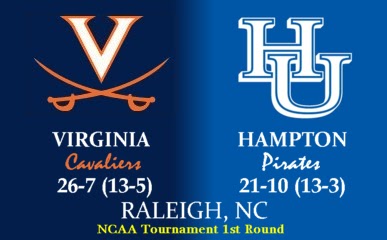
game preview: Hampton


Date/Time: Thursday, March 17; 3:10

TV: truTV

Record against the Pirates: 7-0

Last meeting: UVA 69, HU 40; 11/26/13, Charlottesville

Last game: UNC 61, UVA 57 (3/12); HU 81, SC St. 69 (3/12)

KenPom:

Tempo:
UVA: 61.4 (#351)
HU: 72.2 (#44)

Offense:
UVA: 118.4 (#9)
HU: 100.0 (#244)

Defense:
UVA: 91.9 (#4)
HU: 104.8 (#192)

Pythag:
UVA: .9483 (#2)
HU: .3663 (#220)

Projected lineups:

Virginia:

PG: London Perrantes (11.0 ppg, 3.0 rpg, 4.4 apg)
SG: Malcolm Brogdon (18.7 ppg, 4.1 rpg, 2.8 apg)
SG: Devon Hall (4.5 ppg, 2.5 rpg, 1.8 apg)
PF: Isaiah Wilkins (4.6 ppg, 4.1 rpg, 1.4 apg)
PF: Anthony Gill (13.3 ppg, 6.1 rpg, 0.6 apg)

Hampton:

PG: Reginald Johnson (18.3 ppg, 3.7 rpg, 4.1 apg)
SG: Lawrence Cooks (8.0 ppg, 3.6 rpg, 1.5 apg)
SG: Brian Darden (13.2 ppg, 2.1 rpg, 1.9 apg)
SF: Quinton Chievous (17.0 ppg, 11.0 rpg, 2.1 apg)
PF: Dionte Adams (5.2 ppg, 5.8 rpg, 0.6 apg)

Last chance.  This is the best senior class for UVA hoops in quite a while.  Three different players in it have won ACC honors of some kind - Player of the Year, DPOY, 6th Man, you name it.  The cruel reality of the NCAA tournament is that hundreds of seniors will end their college careers with a loss, and only a tiny handful can say otherwise.  Whether Brogdon, Gill, Tobey, Nolte, and Kirven can avoid the usual fate of seniors remains to be seen, but they're writing the last piece of their legacy regardless.

It's not just the careers of five seniors, though, that are wrapping up.  This is also the last page of the First Book of Tony in the UVA basketball bible.  These guys - Brogdon in particular, way back in August of 2010 - made their commitment very early in the Tony Bennett era.  We're still carrying over from the initial rise to the top.  (And yes, with ACC banners in the ceiling and being ranked at times #1 in the AP poll and in KenPom, it's fair to say UVA has been at the very top of the basketball world.)  This is the final chapter.  When this tourney is over, whether after one, two, or three weeks, the next time the sun rises on UVA basketball it'll be the same author, but a new book.  Hopefully it's more "Harry saves the day and gets rid of Voldemort for now" and less "holy shit, they killed Ned."

-- UVA on offense

Hampton, on the surface, is a respectable defensive team - the stat that really drags down their defensive efficiency is "free throw defense."  I maintain that's not entirely out of one's control - fouling other team's guards will generally result in higher free throw percentages than fouling their bigs - but Hampton's guards aren't very foul-prone.  Their bigs are; maybe they foul lane drivers a lot.  Regardless, Hampton has played solid defense all year long, to just go by the efficiency stats.

Against MEAC competition, that is.  Against bigger fish, their tempo has worked against them and they've been flattened.  Colorado scored 95 in 75 possessions.  SMU rolled up 105 points in just 69 possessions, which is more than 1.5 points per.

Hampton's lineup being essentially a four-guard setup just about all the time, opposing big men tend to have a field day on them, even in losses.  The best comparison is probably Colorado's Josh Scott, one of the Pac-12's best centers and scorer of 21 points and 8 rebounds against Hampton.  UVA has made no secret of their intent to feed the post early and often, and Anthony Gill should be about that productive.

Surprisingly for an up-tempo team, Hampton doesn't pressure a lot on defense, so UVA will have room to work.  Malcolm Brogdon and Devon Hall will both tower over whoever guards them, and outweigh them by 20-30 pounds, too.  Hampton does good work on the boards at both ends, but with the height advantage UVA has at any position you like, there'll be second-chance points, too.  Execute as per usual and the scoreboard will light up.

-- UVA on defense

The Pirates want to push on offense, so one thing that will limit those second chances for UVA is a likely extra emphasis on getting back - more so than usual even for Tony Bennett.  Some teams - like, some we know real well - will pass on a good shot in order to look for a great one.  Hampton just takes what's there and then crashes the offensive glass, hard.  They have three players in the top 300 in offensive rebounding, per KenPom's figuring.

For the most part, Hampton's starting guards are volume scorers.  Brian Darden is a low-percentage, high-volume shooter whose efficiency numbers are saved mainly by his almost impeccable free-throw shooting.  Reginald Johnson can get to the rim fairly well and gets fouled all the time, but he's a senior whose career three-point shooting is under 30%.  Doesn't stop him from shooting - he's launched 173 of them this year.

Hampton's biggest offensive threat - besides their propensity to try and beat you down the court - is the interior games of their biggishes, Quinton Chievous and Dionte Adams.  Chievous gets some putbacks, shoots 63% from two, and mainly eschews the jumpers - though he will at times shoot a three and very, very occasionally make one.  He's much more of a threat down low - but you can save a lot of points by fouling him, because he misses more free throws than he makes.  Hampton's biggest guy is 6'8", 250 Jervon Pressley, who's a shot-blocker but a liability on offense.

Conventional wisdom says you beat UVA by shooting threes, as aptly demonstrated by UVA's 1-3 stretch in January where the winning opponents (VT, GT, FSU) combined to make more than they missed, and UVA's only win (Miami) couldn't buy one.  Hampton cannot shoot threes.

-- Outlook

After the last couple years, in which both Coastal Carolina and Belmont put a scare on the Hoos and threatened to list them among the all-time tournament upsets, I ought to be highly cautious.  It's hard, though, when the opposing offense is so badly geared to succeed against one of the nation's best defenses.  One day, somewhere, a 16 seed will beat a 1, but there's no point ever trying to predict it.

Final score: UVA 82, HU 63

Wednesday, March 9, 2016

a look around

We have a slight pause between the regular season and postseason, so it's time to take stock of how things are going in UVA's major sports.

Basketball, obviously, is pretty much the way it's been since Joe Harris knocked on Tony Bennett's front door a couple years ago.  The team could literally take a collective dump at center court on Thursday and then stagger off the court smashed on Wild Turkey, and they'd still be a three seed at the barest of minimums.  Since theydo actually plan on trying to win a basketball game (against either Clemson or Georgia Tech), the only drama left when it comes to tournament seeding is: 1 or 2?

Right now they're Joe Lunardi's third #1.  (And in a bracket that sets them up on a potential crash course with Buddy Hield, which would be excellent theater.)  That said, Michigan State and Xavier are strong candidates to take that 1 seed with strong tourney runs - and let's face it, MSU has to be considered the massive favorite in the B1G tourney just because of Izzo and their evil vampire nature.  (Come to think of it, I would consider them the massive favorite in the NCAA, too, without a powerhouse team in the bracket to apply the stake to the heart.)  UVA would be at risk of dropping to a 2 seed if they didn't make it to the ACC championship game on Saturday - but would be close to a lock for a 1 if they did.

Attention must be paid to Malcolm Brogdon, opening up a new door in ACC history with the never-before-seen feat of winning ACC POY and DPOY in the same year.  The two awards are clearly linked to each other, though, because the conference's two leading scorers are Tobacco Roadies.  In other words, Brogdon isn't POY without being DPOY.  The interesting thing is that the POY vote wasn't all that close, and his defensive stats don't really stand out.  He's not a machine for either blocks or steals, which is usually how you win DPOY.  You have to actually pay attention to UVA games to know Brogdon's value on defense - which is to say, UVA has become must-see TV for ACC journalists.  Quite likely, they noticed how Brandon Ingram stopped lighting up the scoreboard when Brogdon was assigned to him.

The ACC tournament sets up well for UVA.  The other side of the bracket has the conference's top three offenses (UNC, Duke, Notre Dame); the only top team in the conference that UVA didn't beat (Duke) didn't earn a double bye and needs to take their thin lineup through a gauntlet.  That said, it's a shame Louisville isn't involved - it'd be tougher to get through, but man, six teams like the ACC has at the top, plus some danger mice like Clemson and VT, would make for an ACC tourney for the ages.  Or really, just the way things should be every year.

Speaking of Louisville, though - are we liking this new tradition of going out on Senior Day and bombing some highly-ranked but temporarily hapless opponent back to the Stone Age with Dick Vitale in attendance?**  And capping it with a three-pointer from a senior walk-on causing the roof to blow off the place? Senior Days don't get better than that.  And I've been sticking up for Mike Tobey all year - I think he gets slapped with expectations and standards that are different from everyone else's, and unfairly criticized as a result - and it was therefore doubly awesome to see him own every square inch of the interior.  And since Thomas Rogers's cherry-on-top three against Syracuse two years ago is still my favorite UVA basketball moment of all time, watching the rerun starring Caid Kirven was like hearing a favorite song on the radio that the DJ never plays.  I could watch that show over and over.

**Don't underestimate the presence of Vitale.  First of all, I don't give a shit what anyone says, I like the guy, a lot.  And second, on the same day that Duke and Carolina were playing at Cameron, ESPN put UVA in the prime-time slot and sent Dickie V to Charlottesville.  UVA-Louisville trumped Duke-UNC.  How about that?

*************************************************

March 10 is approaching quickly enough that you might read this afterwards.  It's significant in this context for one thing: six years ago, it was the day that Mike London picked up his first two commitments of his first full recruiting class.  That would be David Dean and Clifton Richardson.  Bronco Mendenhall is unlikely to beat that pace, which, of course, is fine.  Mendenhall has really cranked up the offer cannon, and hardly a day goes by without a new one going out.  He's already held two junior days, both of which were highly attended.

I don't think that all these offers are actually, like, offers.  Bronco's not going to be one to tell you you have an offer when really you don't, but he's got to get out front of the relevance train, and there are ways to let a guy claim an offer while making sure he knows he's got to continue to earn it.  There's a feeling-out process going on.  An offer that goes out might be to see if the interest is mutual, or to keep UVA in the game while Bronco continues to evaluate.  Or a combination of the two.

Meanwhile, the feeling-out process is both ways.  There's clearly interest in what Bronco is putting together, but no prospect could ever be faulted for doing his homework.  Mike London was more familiar to everyone locally.  Nearly all his 2011 class was from Virginia or Maryland, and he was already a somewhat known quantity to the recruits he was talking to.  Now we have guys who either were not hearing from UVA before, or had been but under a totally different regime.  It's encouraging that the combined junior day attendance (between the two that've been held so far) was around 50.  Should we be surprised that the process is taking a little bit of time to ramp up?  Not remotely.

*************************************************

And finally, our beloved spring sports....are showing the rust something fierce.  The baseball team is already loaded down with long-term injuries just a couple weeks into the season, and the bullpen has blown a few leads.  And the lacrosse team....pfff.

It's interesting, actually, that a lot of the reaction to the loss to High Point was not "Virginia is really losing their dominance" but "The blue bloods are really losing their dominance."  I think that's a little bit of a confirmation bias thing.  Most people want there to be more parity in lacrosse, and many are rooting for the "blue-bloods" to lose their hegemony even if they're a fan of a blue-blood.  They just don't want it to be their blue-blood.  And parity in the game is slowly increasing.

But it's really coming more at the expense of the middle tier than the top.  ACC teams are having a fairly tough time this year, and Hopkins has been vexing their fans for a while now, same way UVA has.  But that's nothing compared to how the older middle-tier teams are looking.  Teams like Georgetown, Delaware, St. John's, UMass - formerly tough wins under any circumstance, and now complete pushovers.  Sure, it's not a good sign for lacrosse royalty that teams like Cornell and UVA are no longer powerhouses, but the real brunt of the power shift has been felt further down.

Which means that UVA's struggles - some bad losses and some ugly wins - are more about UVA than the tide of change.  Because let's face it: If Dom Starsia is gently steered toward retirement, which he probably should be if the season continues the way it started, you're nuts if you think the job would have any trouble attracting qualified candidates.

And if you think a 9-4 baseball team is any reason for panic, you learned nothing last year.

Tuesday, December 22, 2015

terra nova

In calling the Villanova game a potential rock fight, I didn't mean throwing pebbles into the ocean, but that's what you'd guess was happening the way the Hoos and Cats rolled the scoreboard up.  The main surprising thing isn't scoring 86 points.  The main surprising thing is doing it in only 60 possessions, the second-slowest game all year.

When you score 86 points against Morgan State, everyone eyes glaze over and they find a more interesting game to write about.  When you do it against Villanova, people notice - and now Tony Bennett is an offensive mastermind.  These are largely the same players that beat Rutgers 45-26, by the way.

It's all part of a program's metamorphosis into something special.  Mike Krzyzewski isn't known as a great offensive or defensive coach.  He's just known as a great coach.  Even before the Tennessee turnaround, Tony Bennett was getting accolades for his defense, and attention of all varieties for his desire to beat shot clocks into mewling submission.  That's great.  It's an identity, and one I truly enjoy.  I love that the arena gets its loudest for something as mundane as a shot clock violation.  I embrace the pace, and I know for sure Tony won't stop recruiting and selling his defense.

Still, it's one thing to get to the top.  UVA's climbed one Everest already by scrawling its name in the annals of the ACC championship.  Staying there is harder.  Old cliche, but so true.  You have to find and eliminate your weaknesses before the competition does.

That's why that Villanova game was a thing.  If the West Virginia game was proof of the season's chemistry experiment coming together, Villanova is proof the mortar has dried on the program foundations and the walls are ready to go up.  Take one of the really good defensive teams in the country and ruthlessly exploit their weaknesses instead of letting them jump on yours - that's how to keep on winning basketball games.  Not just this year, but in the long term.

************************************************

-- The flip side to the offensive volcano is that Nova scored 75 points on those 60 possessions.  That's a lot for a Tony Bennett defense - but then, in the play-by-play I counted 11 points off of quick-change turnovers that the defense had nothing to do with.  Without those..... well, that's still kind of a lot for a Tony Bennett defense, but well within acceptable parameters for a top-20 opponent.  The halfcourt, set-it-up defense looked as good as ever.

-- Nervous nellies will rightly point out that UVA isn't going to shoot 8-for-12 from three very often.  No, they won't, but they will if they create as many open looks as they did.  This wasn't luck, it was the product of really crisp and beautiful ball rotation that resulted in probably half those attempts coming completely uncontested.

-- One of them was kinda contested, but it was my favorite of the day.  Malcolm Brogdon walked upcourt, dribbled the shot clock down to five just because Nova was letting him, then took two steps at the basket, pulled up, and nailed it.  That was pages one through seventeen of the Kobe playbook.  Normally that kind of play why I think the NBA game is much less interesting than college, but we already know Brogdon's character and there isn't a me-me-me strand anywhere in his DNA.  But I've already gone on record saying he can and must be the alpha wolf this year, and a little selfishness on his part will go a long way for his teammates when they start finding themselves unguarded.  Jay Wright's a damn good coach and he was basically throwing up his hands in surrender with his postgame quotes, asking what do you do with a problem like Malcolm?

-- A particular pet peeve of mine is the contingent of Mike Tobey haters the fanbase has.  They have a certain expectation of what Tobey should be, which he isn't, and fail to appreciate what he actually is.  This is a problem nobody else on the team has.  Tobey's lone bucket of the Villanova game, though, came from being what they wish he was.  It won't shut them up, because it's all about consistency and why doesn't he tear someone's head off every possession, you see, but still.

(His first foul was the same.  I don't know how everyone in the arena sees a jump ball and the refs see a foul.  A shooting foul!  That was completely bizarre.)

-- The last time more than one UVA player scored 20 points in a game was three years ago against UWGB, when Akil Mitchell and Joe Harris had 20 apiece.  I bet it happens again this season.

Thursday, December 17, 2015

game preview: Villanova


Date/Time: Saturday, December 19; 12:00

TV: ESPN2

Record against the Wildcats: 4-2

Last meeting: Nova 73, UVA 63; 3/20/04, Philadelphia

Last game: UVA 70, WVU 54 (12/8); Nova 76, La Salle 47 (12/13)

KenPom:

Tempo:
UVA: 63.5 (#348)
Nova: 67.4 (#299)

Offense:
UVA: 115.9 (#7)
Nova: 113.2 (#17)

Defense:
UVA: 90.4 (#5)
Nova: 90.0 (#4)

Pythag:
UVA: .9455 (#1)
Nova: .9333 (#4)

Projected lineups:

Virginia:

PG: London Perrantes (10.4 ppg, 2.9 rpg, 5.1 apg)
SG: Malcolm Brogdon (16.9 ppg, 4.3 rpg, 2.7 apg)
SF: Darius Thompson (8.4 ppg, 2.6 rpg, 2.2 apg)
PF: Anthony Gill (13.4 ppg, 6.4 rpg, 0.4 apg)
C: Jack Salt (3.1 ppg, 1.6 rpg, 0.0 apg)

Villanova:

PG: Ryan Arcidiacono (12.3 ppg, 2.0 rpg, 4.1 apg)
SG: Jalen Brunson (10.8 ppg, 1.8 rpg, 3.4 apg)
SF: Josh Hart (15.0 ppg, 7.1 rpg, 1.8 apg)
PF: Kris Jenkins (10.6 ppg, 3.3 rpg, 1.6 apg)
C: Daniel Ochefu (8.9 ppg, 8.2 rpg, 1.1 apg)

I've said this about a couple different schools, like Georgetown, but I don't know why UVA and Villanova don't play each other more.  The last time was over ten years ago and it was the NIT committee who arranged the matchup.  The time before that was also in the NIT.  The last time these two schools played each other on purpose was 1989, which seems silly.  They're a four-and-a-half hour bus ride apart and right next to each other alphabetically.  There's plenty of tradition on both sides.  It makes sense, dammit.

The Hoos jump straight from finals break to one of the most challenging games they'll have all year.  Villanova went 33-3 last season, lost three of their top players, and apparently didn't miss a beat.  Every single one of their games has been a blowout - although one of them wasn't exactly in their favor.  The flip side of that is that they haven't been tested, save for a trip to Hawaii to play a neutral-site game against Oklahoma, which got them killed.  They've played one road game - against St. Joseph's, which isn't so much a bus ride away as it is a carpool.  Nevertheless, they haven't allowed themselves to fall victim to any tripwires, as they've played a few teams that are at least capable.  They'll give UVA a handful in a game with an ACC-like feel to it.

-- UVA on offense

Villanova took Kris Jenkins out of the starting lineup after the Oklahoma disaster, and replaced him with the much smaller Phil Booth, but it's a good bet Jenkins will be back against UVA.  Nova would be laughably undermanned against Anthony Gill otherwise.  Jenkins is a little on the short side at 6'6", but he's beefy and against a lineup with Gill and a true center, he's Villanova's only hope.

Nova is, on the whole, an excellent defensive team.  Even the OU loss was more on the offense than the defense.  They stay in front of their man very well and have center Daniel Ochefu to wipe out a lot of mistakes.  He's a terrific shot-blocker, and lanky Mikal Bridges, playing forward off the bench, creates a lot of havoc on the defensive end too.  Villanova plays smart and fouls very little, and the result of all this is that teams typically have to shoot well from three to have a chance.

The hole, of course, is that they don't have much of a frontcourt outside of Ochefu.  Jenkins, really, plays a small forward's game.  Bridges and Darryl Reynolds play significant rotation minutes off the bench, but Reynolds leaves a hole on offense when he's in.  Nova has good backcourt size, but that doesn't help in scrambles underneath the basket, and second-chance points will be a concern for them all year - especially going up against a good offensive rebounding team on Saturday.  Ochefu does really excellent work on the boards, but he plays only half the time.

UVA probably won't get a lot of opportunities to drive at the rim, as the Wildcats do a good job at preventing it.  But they should be able to pound the ball inside, substituting to try and force mismatches with Gill and Isaiah Wilkins.  Mike Tobey probably won't light up the stat sheet, because Ochefu is a major handful - but simply by existing and occupying Ochefu, he'll force Nova to guard UVA's power forwards with someone who isn't well suited for it.

-- UVA on defense

This could be an exciting matchup for the pack-line.  Nova is a perplexing team on offense.  They finish really, really damn well at the rim.  Kris Jenkins and Josh Hart are both shooting 80% at the rim, and this is not on putbacks because this team, outside of Ochefu, simply doesn't do that.  When they get offensive rebounds - which isn't often - they reset, rather than going back up.  Not surprising for a team of mostly guards.  I digress.  This team does very well driving to the bucket.

Fortunately for their opponents - especially, say, an opponent whose defensive system is designed to slam the door on any attempts to drive the lane - Villanova is 1) in love with the three-ball and 2) not that good at it.  The reason they lost so badly to Oklahoma is they shot more threes than twos and hit on four of them - out of 32.

They were much better at it last year, and shooters gotta keep shooting, so eventually they might snap out of it.  Maybe on Saturday.  But so far this year, only Ryan Arcidiacono has been a threat as a distance shooter.  Jenkins, Bridges, and Jalen Brunson are all in the 20% range so far.  They've rolled their opponents anyway because they're so damn good inside the arc (against Georgia Tech, for example, 19-of-24 for two) and other than Ochefu, mostly automatic free-throw shooters, but they settle for threes a heck of a lot.  They could win a lot of games from the stripe, but they're near the bottom of D-I in free throw attempts.  They have this very peculiar statistical arrangement:

- #4 in the country in 2pt %
- #277 in the country in 3pt %
- #254 in the country in percentage of points coming from two
- #36 in the country in percentage of points coming from three

That is the fingerprint of a team that shoots way too damn many threes.  So pack-line 'em up.  This Villanova team is designed to be stopped by it.  When Nova throws it inside to Ochefu, they'll be dangerous, because dude's a hoss.  When they get past the gate sentries, they'll be dangerous, because they finish so well.  If they're content to settle for threes, and they have been all year, UVA will take it.  I suppose Nova could be an unstoppable force if they ever actually start hitting those threes, and we can't have nice things so they'll probably choose Saturday to start.  But UVA rebounds really well even against teams with actual power forwards, and it adds up to a very bad matchup for Nova's offense.

-- Outlook

This game stands a good chance of being a rock fight.  UVA's tempo is certainly up thanks to the shot clock - they're five possessions faster than they were last year and the highest they've been in the Tony Bennett era.  But still they're one of the slowest teams in the country.  Offensive average possession length is clearly faster.  Defensive possession length - hardly any change at all.  Villanova is not a run and gun team either; they're nearly as deliberate and force long possessions as well.  Add in that both teams play excellent defense and one team is a nightmarish matchup for the other's offense, and this game will likely struggle to hit the 70s, if not the 60s.

I said the other day that it looks to me like UVA's chemistry experiment is finally producing a reaction.  West Virginia was held to 54 points in 65 possessions, and just 18 in the second half.  If I'm right, UVA, playing at home and against an opponent that likes to do things that play into the hands of the pack-line, should win this one.  If I'm wrong, Villanova will find defensive breakdowns and derail the good vibes from the WVU win.  I might as well stop writing if I'm to call myself wrong a day after writing it.

Final score: UVA 63, Nova 54

Wednesday, November 4, 2015

basketball season preview, part 1

You know you want it.  Here it is.  Tipoff is, as of typing this sentence, 8 days and 21 and a half hours from now.  UVa basketball is a legitimately elite team.  The media and coaches both ranked the Hoos #6 to start the season; one intrepid member of the media poll decided they should be #1.  KenPom starts them off 3rd.  Nobody finds this strange anymore.

UVA is staring down a familiar ACC - one in which Duke and UNC are again the primary threats to world domination and VT is hot garbage but this year will be improvement you guys - and one of the toughest out-of-conference schedules of anyone in the nation.  December kicks off with a trip to Columbus, Ohio, and later a three-game stretch against West Virginia, Villanova, and Cal.  Worthy opponents will also be found in Charleston for the usual preseason tournament, which hopefully culminates in a championship game against Oklahoma State.

The 30-second shot clock this year, down from 35, almost certainly means it'll be much harder for Tony Bennett's famous defense to ring up freak-show scores like 45-26 or 57-28, or hold opponents to eight points in a half.  But it could also mean some larger margins of victory; if you can't score in 35 seconds on this defense, a shorter time limit isn't likely to help.

We'll start off here with a three-part series on the players themselves, which is as per usual except usually it's a two-part series.  Three this year, which you shouldn't read anything into except the fact that it takes a really long time to type this stuff up.  Because his number comes first in the alphabet, we start with....

#0 - Devon Hall - rSo. PG

Life's not easy as the tenth player in Tony's 9.5-man rotation.  You have to have the mindset of a relief pitcher.  Nobody, absolutely nobody, comes out of high school thinking that way.  Devon Hall redshirted, then spent last year bouncing between long stretches on the bench and long stretches on the court.  He started the first game while London Perrantes served a suspension, then saw his minutes vaporize when ACC season rolled around, then jumped right back in when Justin Anderson was hurt near the end of the year, then played zero minutes in all postseason games.

Anderson is in the League now, but the backcourt minutes aren't much less logjammed.  Hall looks once again like the sixth player in the rotation for three spots' worth of minutes.  Much depends on his offseason improvements - more so than anyone else in the backcourt.  Hall wasn't a force on offense last year; he struggled from the free-throw line in limited opportunities, didn't force opponents to account for his outside shooting, and missed too many two-pointers as well.  The offense never ran through him; instead it occasionally ended up in his area.

Anderson averaged about 28 minutes a game, but it's not hard to envision that being taken up by Marial Shayok (maybe ten extra minutes), Darius Thompson (fifteen?) and Evan Nolte, who is after all a senior.  Hall wasn't a standout on defense last year, but he played it well enough to be inserted into the lineup with little hesitation.  He's going to have to show something on offense to nose his way onto the court.  It's a delicate balance between asserting yourself enough and too much, and Hall needs to find it early if he's going to stick in the rotation.  If he can do that, his size will be a real asset and help to make UVA a truly imposing presence with one of the biggest backcourts in the nation.  Otherwise, he'll spend another year picking up the scraps and making it difficult to tell what exactly he does well.

#4 - Marial Shayok - So. SG

College basketball teams have to reinvent themselves a little bit every year.  They lose some unique talents to transfer, graduation, or the draft; new faces arrive; old faces add new talents.  Case in point: Justin Anderson finding a three-point shot.  One of my favorite things about new basketball seasons is finding out how the new rotation meshes, how the chemistry equation sorts out, and most especially, unwrapping the new surprises.  With Tony Bennett the latter is better than ever, because amazing coaching means major offseason improvements.

All that in mind, here's the holdover player I'm most excited to see this year.  Marial Shayok is a big reason why the Devon Hall preview was so pessimistic.  Generally, the upperclassmen are what they are.  Shayok is, potentially, a lot of things.  Last year he came in billed as a very versatile player, and delivered 100% on that promise.  Lot of tools in his toolbox; he's a very skilled defender, and can score a bunch of different ways.

One thing I'd like to see most is either better mid-range shooting, or a lot less of it.  Shayok can hit the three and he's one of the team's best finishers at the rim.  His 62.5% percentage at the rim (according to Hoop-Math) is big-man-esque.  He can achieve a huge boost in efficiency by focusing on the shots with much higher reward potential, or he can level up even more in versatility by improving his mid-range game to, say, 30-35% instead of the ugly 23.5% he shot last year.

Shayok, obviously, isn't Justin Anderson's equal athletically - very few are.  But he's got a great feel for the game.  He's a Swiss Army knife of a basketball player, not easily pigeonholed into a particular position.  His many skills, though, are still raw and undeveloped.  Whichever of those skills he improved most over the offseason will not only help himself find well-deserved playing time, but more importantly, it'll determine what chemistry combinations work best in this year's experiment.

#10 - Mike Tobey - Sr. C

Everyone's favorite enigma, a senior at last and hopefully ready to come blasting out of his shell.  Sort of - because I'm one who maintains there isn't much of a shell, just a talented center developing at about the usual pace for a center.  Tobey has a lot of strong points that show up very loud and clear on a stat sheet - or at least the KenPom kind of sheet.

To start with, he was the third-most efficient player on last year's team, ahead of big names like Brogdon.  This had a lot to do with his very low turnover rate and quality free-throw shooting, two traits it's incredibly difficult to find in a big man.  He was also the team's best rebounder from the efficiency point of view and in fact one of the better ones in the country.

Tobey's detractors want him to "play with more fire," as his game doesn't come off very intense.  You might get a few more blocks that way (and a few more fouls) and he might get to the line a bit more, maybe a little better shooting percentage.  You wouldn't get much extra rebounding, though, because he already does that very well, and his defense wouldn't show it, because he can already neutralize most players his size and isn't quick enough to be a major stopping force against power forwards.

You can make a case, though, that Tobey is the best true center in the ACC.  Other players have a case, too - think Tonye Jekiri of Miami, Landry Nnoko of Clemson - but the thing is, Tobey's best games come against those specific players.  Tobey abuses teams who defend him with other centers - and quickly picks up fouls when he doesn't have other centers to defend against and has to go against power forwards instead.

So if there's anything I want to see out of him in his senior year, it's not "more fire."  He is what he is.  And he doesn't need fire to beat up on other centers on both ends of the court.  Rather, I'd like to see him be able to hang in there longer against players like Zach Auguste, who's not a true center but can bang around inside just enough and out-quick Tobey with the ball.  He's got to be able to contribute more against teams who go relatively small inside, because UVA can't simply answer with Darion Atkins anymore.

#11 - Evan Nolte - Sr. SF

Another enigma - which is sort of weird for a pair of seniors.  Nolte looked like he was on the outs halfway through last year, with only a few token minutes a game.  Then, like Hall, he appeared back in the rotation with a vengeance when Justin got hurt - and unlike Hall, stuck even when Anderson returned.

Before that Louisville game, he was 7-for-35 shooting three pointers.  Horrendous, and a glaring problem, because that's what he was in the game to do.  In the last one-third of the season he was 14-for-41 - much, much better, and there were two consecutive games there where he was 0-for-8, so outside that little blip, he shot 42%.  It lends credence to the idea that you can expect his shot to be much better this year.

Nolte also figured out how to be a very consistent defender, adopting an awkward-looking defensive stance that works like a damn charm.  He will never, ever get a steal out of his on-ball defense, but more power to you if you can recall anyone getting past him once he got down in that duck stance.  He also formed a bridge between frontcourt and backcourt, playing the four on occasion.  While Nolte at the four and Tobey at the five is a combination that will happen exactly never, putting Nolte at power forward is a great way to punish an opponent for going too big - particularly if he's hitting from outside.

I doubt there's much evolution left in Nolte's game.  His defense is fine.  He's not going to light up the stat sheet, but he's far, far from a liability.  He's not going to go with his back to the basket unless someone tries to guard him with a 6'2" shooting guard.  The only real variable here is the three-point shooting, which comes and goes for almost everyone.  If he's hitting, great.  Really great.  If he's not, he needs to keep bombing away until he is.  It would be hard to be worse than he was at the beginning of last year, so just a little regression to the mean is all he really needs.

Monday, April 20, 2015

hoops in review, part 1

This was promised to you much earlier, but then I realized: if I write this before Justin Anderson makes his decision known, the whole thing will be littered with uncertainty and caveats.  Now we know, so we can get the show on the road.

#0 - Devon Hall - rFr. PG

Preview quote: "UVA's backcourt is fairly young this year, so a good-sized contribution from Hall is more important than it might seem."

This didn't turn out that way, because there was such a quantum leap forward from other players.  Justin Anderson, of course, and London Perrantes also became more of a scorer.  Hall was decidedly the last rotation option in the backcourt, and scored more than three points just three times.  He sat out 11 games entirely, and in ACC action, saw just over five minutes a game - that is, outside a particular stretch late in the season.

That would of course be the stretch that Anderson missed.  Hall didn't play against Pittsburgh, but averaged 15 minutes in five others.  And when London Perrantes was suspended to start the season, Hall got his only start of the year, in game one against JMU.

And that in a nutshell was Hall's role: it was other guys who ran the show, mostly, but when a spot opened up, Hall was counted on for a decent share of the minutes.  Redshirting and then the understudy role probably wasn't what he envisioned to start his career.  But it's hard to say he deserved scads more time; his defense was OK but not outstanding (that said, the point guard isn't asked to be the star of the pack-line) and his offense wasn't as efficient as you'd like.  He showed some flashes at times.  The Wake Forest game - the curbstomping, not the close one - was a particularly excellent showing.  But overall he played about as well as his minutes imply.  Not lousy, or he wouldn't have been the first option to replace a regular in the rotation - but not much to take note of.

Anderson's departure opens up about 28 backcourt minutes.  Perrantes and Malcolm Brogdon are just about maxed out, but the competition is still going to be fierce for them.  Darius Thompson joins the fray next year, and it's whispered he brings a quickness and slashing dimension to the team that was lacking this year.  Marial Shayok is due for a big increase too.  Hall will have to work his tail off this offseason if he wants to make a large dent next year.  His role should increase, but it probably won't be til 2016-2017, after this large crop of rising seniors graduates, that he really becomes one of the front-and-center players.

#1 - Justin Anderson - Jr. SF

Preview quote: "He's got to take some part of his game - any part of his game, it really doesn't even matter - up a level or two."

I don't know.  Do you think he might've accomplished that?

I guess if going from under 30% to over 45% behind the arc counts.  Anderson actually cooled off as the season went on, because he started up over 60% - after Tennesee State, which he buried with 5-for-5 three-point shooting, he was over 68%, five games in.

That was enough to capture a lot of attention nationwide, but Anderson also gave a few other parts of his game a lift - he became more dependable from the free throw line, he fouled less and played better defense overall (though with fewer circus blocks, unfortunately) and he took better care of the ball.  He singlehandedly answered the question of who would replace Joe Harris's scoring, and became the infectiously enthusiastic face of the whole team.  And then, because We Can't Have Nice Things, he broke his damn hand.

That was really what drove home the point about what he meant to this team.  UVA only lost one game without him, but they weren't easy wins, and three out of his four games after his return were a mess.  He scored zero points in the whole ACC tournament and only defensively-challenged Belmont allowed him to look like his former self.  Anderson's play suffered, and along with it basically the whole offense.

A terrific shame.  Anderson was an exciting player his first two years, but he was a ridiculously athletic curiosity for the most part.  An X-factor, but the game was dominated by others.  This year he took over and became the guy Maryland fans are still pissed off about missing out on.  This is what's most disappointing about Anderson leaving.  The team, actually, will be just fine.  Tony Bennett is working on a nice track record of seeing his players take huge strides in the offseason, and no doubt someone will do the same this year.  Or a couple someones.  In fact, the team might be best off in the long run for this - if Anderson returned, the backcourt would've been incredibly crowded.  Now, some younger guys will get extensive playing time and the baton will be more easily passed off in later years.  But a full year of a guy like Justin Anderson in a starring role would've been some of the best entertainment in all of college hoops.

#2 - B.J. Stith - Fr. SG

Preview quote: "Stith has a good head on his shoulders and a dad who won't let him screw himself up, so I'll put in a SWAG here and say Stith redshirts."

Well, that was over quick.  Stith didn't redshirt, but he might as well have for all the playing time he got - almost exclusively with the walk-ons at the end of blowouts - and amid a smattering of talk that cracking the rotation might not ever be in the cards, Stith decided to rejoin his father and brother at ODU next year.  We won't get to see the second chapter of a Stith lighting it up in a Virginia uniform after all.

#4 - Marial Shayok - Fr. SF

Preview quote: "Shayok's calling card when he came in was his versatility."

Honest, I totally forgot that I'd written that as I watched Shayok this season and thought, "man, this guy can score a lot of different ways."  Versatile was exactly the word for what he did with the ball.  He showed he could get to the rim; he showed he could shoot the three; he showed he could create a few chances for his teammates.  He played a reasonably steady 15 minutes a game - right about average for the fourth guy in the backcourt rotation - and had a higher assist rate than everyone but Perrantes and Brogdon, the team's highest steal rate, and the backcourt's best block rate.  A better block rate than Anderson, in fact, and Anthony Gill as well.

You can't ask for a lot more out of a bench guy, and you can't ask for preseason impressions to turn out much more accurate than that.  Shayok didn't do anything dominatingly well, and he was plagued with occasional freshman inconsistency, but he did a hell of a lot of different things at an ACC level.  Out of a fairly large group of freshmen, Shayok was easily the best.

A guy who can score a lot of different ways is a good bet to find chances to do it more often.  Shayok doesn't have the kind of wild athleticism you see in early draft entrants, and that means Tony Bennett might have hit the sweet spot in recruiting here.  Shayok appears to have a well-developed court sense and has a great chance to be a four-year star for the Hoos.  And for that matter, a three-year starter.

#5 - Darion Atkins - Sr. PF

Preview quote: "Atkins probably won't start many games, if at all, and isn't a huge scoring threat. He probably trusts his hook shot a little too much."

Nice preview.  Atkins started 27 games, in fact, including all of them but one after New Year's, and in that one he played 31 minutes.  Oh, and he was one of the most indispensible players on the team.  ACC Defensive POY.  That hook shot I thought he trusted too much became a deadly weapon.  Simply put, he was one of the ACC's best interior forces anywhere.

Atkins got back all the bounce and athleticism he'd lost when the shin splints struck him two years ago.  And he played with a chip on his shoulder, as if making up for lost time and getting revenge on the fates that robbed him of a year and a half of usefulness.  It was so much fun to see him get that redemption and his year in the spotlight that nobody minded a bit when he got a technical for hanging on the rim against VT.  Sometimes you just let a guy have a moment.  This was the player that UVA and Notre Dame fought over in the recruiting wars.

Stories like his are what make college hoops fun.  Now there's a small conundrum.  Before the season the whole fanbase figured that "only" losing Atkins would mean basically the exact same team would come back next year, only a year older and stronger and wiser.  Now he's gotta be replaced.  It won't be easy; whereas Atkins was plausibly seen as very similar to Akil Mitchell, there isn't anyone left in that mold, nor much experience among the candidates.

#10 - Mike Tobey - Jr. C

Preview quote: "Keep him on the development curve at the same time and he's got a chance to open a lot of eyes in the ACC this year."

There hasn't been a more polarizing UVA basketball player since Sammy Zeglinski.  With Tobey, whether you like his game or not, there's evidence to support your position.  Tobey was only a secondary scorer at best, and his minutes actually dropped from last year.  He's really not useful against teams without big traditional centers, because he's fairly easily beaten on the block by smaller, quicker forwards.  His defense is a little slow and he doesn't appear to be a natural in the pack-line.

On the other hand, he's extremely useful against teams that do have traditional centers, because he's almost always much more skilled than they are, able to guard them with relative ease thanks to the security blanket of the pack-line and his better athleticism, and he has little trouble scoring against slow-footed galoots.  This season was easily his best offensively.  He was much more efficient than last year; he shot free throws as well as most guards, he was a terrific rebounder especially on offense, he made good outlet passes, and he turned the ball over very little.

I think a lot of criticism directed at Tobey - much of it to do with a perceived lack of effort - is unwarranted.  It's not any more valid than the idea that Atkins was disgruntled and unhappy because his face was kinda hangdog all the time.  Amateur psychology.  That and the expectations heaped on him when he was recruited.  If there were no such thing as recruiting analysts, Tobey would catch a lot less flak.  That said, he can be maddening at times.  He needs to find ways to get himself on the court more.  If he does, he's still got it in him to be an all-ACC player.

Saturday, March 21, 2015

game preview: Michigan State


Date/Time: Sunday, March 22; 12:10

TV: CBS

Record against the Spartans: 0-4

Last meeting: MSU 61, UVA 59; 3/28/14, New York, NY; NCAA Sweet Sixteen

Last game: UVA 79, Belmont 67 (3/20); MSU 70, UGA 63 (3/20)

KenPom:

Tempo:
UVA: 58.5 (#349)
MSU: 64.0 (#216)

Offense:
UVA: 112.1 (#24)
MSU: 113.7 (#16)

Defense:
UVA: 86.1 (#2)
MSU: 95.6 (#48)

Pythag:
UVA: .9544 (#5)
MSU: .8799 (#17)

Projected lineups:

Virginia:

PG: London Perrantes (6.5 ppg, 2.7 rpg, 4.7 apg)
SG: Malcolm Brogdon (14.2 ppg, 4.0 rpg, 2.4 apg)
SF: Evan Nolte (3.1 ppg, 1.6 rpg, 0.7 apg)
PF: Darion Atkins (7.6 ppg, 5.7 rpg, 0.7 apg)
PF: Anthony Gill (11.6 ppg, 6.5 rpg, 0.8 apg)

Michigan State:

PG: Travis Trice (14.8 ppg, 3.2 rpg, 5.2 apg)
SG: Lourawls Nairn (2.3 ppg, 1.6 rpg, 2.5 apg)
SF: Denzel Valentine (14.5 ppg, 6.2 rpg, 4.4 apg)
PF: Branden Dawson (12.0 ppg, 9.0 rpg, 1.8 apg)
C: Gavin Schilling (5.2 ppg, 4.0 rpg, 0.4 apg)

The selection committee insists they don't take storylines into account when they fill out the bracket, and maybe they don't - they certainly have plenty to worry about without looking for transfer players who might get the chance to play against their old team.  But the opening rounds for UVA have certainly not been lacking for interest.

UVA gets another shot at the team that bounced them from the Sweet Sixteen last year.  On paper, Michigan State isn't as good as they were last year.  In real life, MSU has a reputation as a tough out for a reason.  And just going by KenPom rankings, they're more a high 5-seed than a 7-seed.  They clamped down on Georgia in round 1; the Bulldogs only made one shot in three.  Your reward for a top-2 seed is to open the tourney against some scrappy little upstart that you can probably fry like an egg; the real tourney begins now.

-- UVA on offense

Despite the great work against UGA, in almost all of their losses, MSU topped the point-per-possession mark.  Their problem was occasionally letting bad teams score a bunch.  Minnesota, Nebraska, even Texas Southern early in the season; MSU usually doesn't have much trouble scoring, but their defense can occasionally buckle on them.  They generate good numbers, they just get a little inconsistent - a strange thing for a Tom Izzo team.

MSU is a little undersized.  Matt Costello and Gavin Schilling play as traditional centers, and rarely (if ever) appear on the court at the same time; both are 6'9", though, giving up a few inches to Mike Tobey.  That said, they're also heavy and solidly built, and can hold their ground just fine.  Other than the very lightly-used Colby Wollenman (who checks in at 6'7") nobody else on the MSU depth chart is over 6'6".  Branden Dawson is athletic and was a potential NBA draft entrant last year, but is only a 6'6" power forward.  So is his second-string, freshman Marvin Clark.  Finally, you've got 5'10", 170-pound shooting guard Lourawls Nairn, who'll draw 6'5" strong-as-an-ox Malcolm Brogdon, unless it's 6'0" Travis Trice instead.

So hopefully UVA will be able to put their size advantage to good use.  MSU is tough to score on when they're playing good fundamental ball; Izzo, though, has bemoaned his team's inconsistency all year, including after the Georgia game when he called his team "interesting."  MSU sometimes puts itself in foul trouble.  Costello and Schilling are strong, but not all that quick, and are prone to fouling players driving to the hoop.  They'll go for the block, and they get it pretty often, but they also sometimes miss and get a hack instead.  The guy to watch out for is Dawson; he's got some leaps and an ability to get those blocks without fouling.  He's a good answer to Justin Anderson in that regard.

Despite the inconsistency, you have to expect a grind.  MSU is also capable of excellent defensive performances; Indiana is one team that found that out, as did Georgia.  There are matchups where UVA will have the upper hand; failure to take advantage would be killer.

-- UVA on defense

The size advantage UVA has is different than what they had against Belmont, for one big reason: UVA was forced to go smallish against Belmont, because the whole team played outside the arc.  Mike Tobey only played five minutes.  MSU's bigs are never shooting threes (Marvin Clark being a possible exception, if you want to call him a big) and so Tobey and the rest of UVA's bigs can do what they're comfortable doing.

Clark will hoist them some, but there's really only three Spartans to care about from long range: Denzel Valentine, Travis Trice, and Bryn Forbes.  All of them will fire away and all of them can hit with regularity.  Limiting the three-bombing to the players that can actually hit them has helped make MSU a really efficient offensive team.

They're also really good inside the arc.  Costello and Schilling kind of look like galoots, but they're strong players and know how to establish a presence.  They do a lot of cleanup work, scoring on putbacks quite a bit.  Schilling usually starts, but it's Costello, often going against opponent's second strings, who does the best work in most facets of the game.

Dawson uses his athleticism very well in getting to the rim, and off the bench, Bryn Forbes is a very versatile scorer.  The most dangerous guy on the court, though, is Valentine.  Valentine has always played with a little bit of an attitude, sometimes not a productive one.  Now a junior, though, he's reined it in a bit and has a great deal more consistency in his game as a result.  Valentine can score from anywhere.  He prefers jump shots and doesn't go to the rim as much, but he's very comfortable shooting from wherever he is on the court.

The one big weakness of the Spartans: Foul shooting.  Valentine is outstanding from the stripe, and Forbes is dependable.  Trice, though, misses more than a guard should.  Lourawls Nairn is a lousy shooter, especially for a guard; Costello is OK for a big, but Dawson is horrendous and Schilling is worse.  This would be a great game to have really whistle-happy refs who call it as tight as possible; if it's a parade to the line, UVA's chances improve tremendously.

-- Outlook

UVA has the advantage here.  The Hoos play better defense and don't have an ugly, glaring weakness the way MSU does with the free throws.  That said, games like this have a way of defying the on-paper analysis. Both teams are comfortable in close games, and this one probably will be.  If there's one intangible on the side of UVA, it's this: Like Memphis last year, MSU won't have had much time to focus on scouting the pack-line defense, needing to worry about their first-round opponent a great deal more.  But I'll frankly be damn good and surprised if this game is a blowout ilke that Memphis one.

Since I did such a damn good job predicting the Belmont score, let's hope this one's just as accurate.

Final score: UVA 61, MSU 59

Thursday, March 19, 2015

game preview: Belmont


Date/Time: Friday, March 20; 3:10

TV: truTV

Record against the Bruins: 1-0

Last meeting: UVA 94, Belmont 74; 12/28/99, Charlottesville

Last game: UNC 71, UVA 67 (3/13); Belmont 88, Murray St. 87 (3/7)

KenPom:

Tempo:
UVA: 58.2 (#349)
Belmont: 67.0 (#68)

Offense:
UVA: 112.2 (#25)
Belmont: 107.9 (#63)

Defense:
UVA: 85.5 (#1)
Belmont: 106.3 (#251)

Pythag:
UVA: .9580 (#4)
Belmont: .5407 (#146)

Projected lineups:

Virginia:

PG: London Perrantes (6.4 ppg, 2.5 rpg, 4.8 apg)
SG: Malcolm Brogdon (13.9 ppg, 3.9 rpg, 2.5 apg)
SF: Evan Nolte (3.2 ppg, 1.5 rpg, 0.6 apg)
PF: Darion Atkins (7.5 ppg, 5.7 rpg, 0.7 apg)
PF: Anthony Gill (11.5 ppg, 6.6 rpg, 0.8 apg)

Belmont:

PG: Reece Chamberlain (8.5 ppg, 5.5 rpg, 6.1 apg)
SG: Craig Bradshaw (18.1 ppg, 3.7 rpg, 3.2 apg)
SG: Taylor Barnette (10.7 ppg, 2.6 rpg, 1.3 apg)
PF: Amanze Egekeze (5.3 ppg, 3.2 rpg, 0.7 apg)
PF: Evan Bradds (14.3 ppg, 7.2 rpg, 1.3 apg)

Win or go home, you know the drill.  You no doubt also know a bit of the (very recent) history here: that it was former Hoo Taylor Barnette hitting the game-winning shot for Belmont that punched their dance ticket.  (This tourney is loaded with former Hoos.  Will Regan is still suiting up for Buffalo and Paul Jesperson is in with Northern Iowa.)

Memories of last year's first-round game are still fresh; UVA found itself down by as many as nine to 16-seed Coastal Carolina.  Belmont - a small school sitting in Vanderbilt's shadow in Nashville - is the kind of team that could make the Hoos nervous again ... but also the kind that could get completely rolled.

-- UVA on offense

Belmont's not the worst defensive team in the tournament - that honor belongs to Eastern Washington - but it's close.  Their efficiency of 106.3 places them outside the top 250 in the country.  Size has something to do with it, but the OVC isn't exactly loaded with seven-footers, either.  Belmont was even crummy within their own conference.

Belmont let most opponents shoot over 50% from inside the arc, especially if that opponent had a functioning big man.  UVA has three.  This is where the Hoos will have just an incredible, unfair advantage.  Belmont simply doesn't have big men.  Tyler Hadden is 6'10", 240 and Mack Mercer is 6'9", 220, and both play about six minutes a game.  Taking most of the big-man minutes are starters Amanze Egekeze and Evan Bradds; Bradds is 6'7", 205, and Egekeze is only an inch taller and ten pounds heavier.

Tobey, Gill, and Atkins are going to have a field day with this.  Belmont has the choice of using players who are barely OVC-caliber, or using guys who are small enough to get posted up by Evan Nolte.  The Hoos are going to want to feed the post all day long; if they find a hot hand, that guy might score 20.  This is to say nothing of the rebounding advantage UVA will have.

It's not only the bigs; our old friend Barnette, more power to him, but he's going to have to guard one of Brogdon, Nolte, or Anderson, and there's a reason he couldn't get on the court much while competing with them for playing time.  Not to single him out; it's more an illustration of the talent difference here.

Frankly, there's no reason UVA shouldn't be able to score a whole bunch.  The patient approach they have is going to break down this defense.  I'd expect a bunch of double-teams to make up for Belmont's lack of size, but with so many mismatches on the floor, it shouldn't matter.

-- UVA on defense

Here's what makes me nervous.  The huge size advantage UVA has is nullified in a way.  Belmont won't be able to drive much and they'll never be able to post up.  They might find some clever passing angles for an open bucket or two, but mainly, they'll be forced to shoot a lot of threes.  Which is exactly what they want to do.

That's how you beat the Hoos, of course.  Belmont attempted more threes than all but four teams in the country, and the thing about shooting is, an open three is an open three regardless of talent level or conference or whatever.  In other words, just because they're a 15 seed doesn't mean a 40% shooter is gonna be any worse against a 2 seed.

Craig Bradshaw leads the way, shooting 42%.  Barnette, of course, has a very green light, and Nick Smith, despite playing only 15 minutes a game, has the third-most attempts on the team.  But truthfully, just about anyone on the court is fair game to fire away.  Mack Mercer, who barely plays anyway, is the only player to be really complacent about.

I think we'll see the post double employed very little - partly because the ball just won't be in the post much, but partly because it doesn't make sense to leave three-point shooters temporarily open so you can double a guy that Anthony Gill could eat for lunch anyway.

With a ton of shooters all bombing away, it's too much to think they'll all go cold all at once.  Some of these are going to drop.  You just figure that the defenders need to be able to close out; fortunately, with no real post threat, there isn't much need to collapse too far in the first place.  Belmont is going to shoot like 20 threes regardless of what the defense does; if most of them are contested, UVA should be able to keep the Bruins at arms' length.

-- Outlook

Belmont has half the traditional formula for a big upset.  They shoot threes - lots of them, and well.  So often, though, the scrappy underdog also has a legit big man who seems like he's everywhere.  No doubt the Bruin bigs are going to scrap, but they're likely doomed to being dominated in all aspects of the game.  I think Belmont keeps it closer than we'd like, shooting well enough to not let the game get out of hand.  But they're not going to play enough defense, either.

Final score: UVA 79, Belmont 66

Thursday, March 12, 2015

game preview: North Carolina


Date/Time: Friday, March 13; 7:00

TV: ESPN

Record against the Heels: 52-128

Last meeting: UVA 75, UNC 64; 2/2/15, Chapel Hill

Last game: UVA 58, FSU 44 (3/12); UNC 70, UL 60 (3/12)

KenPom:

Tempo:
UVA: 57.9 (#349)
UNC: 69.7 (#15)

Offense:
UVA: 112.5 (#23)
UNC: 114.4 (#13)

Defense:
UVA: 84.8 (#1)
UNC: 94.0 (#31)

Pythag:
UVA: .9627 (#3)
UNC: .9055 (#13)

Projected lineups:

Virginia:

PG: London Perrantes (6.3 ppg, 2.5 rpg, 4.7 apg)
SG: Malcolm Brogdon (13.7 ppg, 4.0 rpg, 2.6 apg)
SF: Evan Nolte (2.9 ppg, 1.4 rpg, 0.7 apg)
PF: Darion Atkins (7.6 ppg, 5.9 rpg, 0.7 apg)
PF: Anthony Gill (11.6 ppg, 6.7 rpg, 0.9 apg)

North Carolina:

PG: Marcus Paige (13.7 ppg, 2.9 rpg, 4.6 apg)
SG: J.P. Tokoto (8.7 ppg, 5.6 rpg, 4.2 apg)
SF: Justin Jackson  (10.1 ppg, 3.7 rpg, 2.5 apg)
PF: Brice Johnson (12.8 ppg, 7.9 rpg, 0.8 apg)
C: Joel James (2.7 ppg, 1.8 rpg, 0.1 apg)

Can I just start off by pissing all over the refereeing in the FSU game?  Not that anyone needs it pointed out, it had both coaches fuming and the usually restrained Sean McDonough (whose announcing I tend to enjoy) was more than a little critical.  But still.  I was gonna say it was the usual, vintage Jamie Luckie, but it was absolute shit even by Luckie's low standards.

The ironic thing was that the call that sent Leonard Hamilton over the edge was not only 100% right, but damn well should've been looked at for flagrant potential.

Anyway.  A well-played game by UVA in spurts, and frankly would've felt a lot better if not for a streak of rimmed-out shots early in the second half.  Maybe it's good they didn't fall - gives the team a reason to refocus their efforts in a few places where they were rough around the edges.  North Carolina is another athletic team like FSU - not quite as big, but obviously with a great deal more scoring talent.

As of the moment I type this, Notre Dame has already raced out to a comfy lead against Miami, and there's no real reason they should lose it.  That makes the ACC's final four possibly every bit as good as the one that'll happen in Indy.  It's not going to be an easy road to a repeat, but if the Hoos do pull it off, they'll establish themselves as clearly the class of the ACC, and start to induce whispers about a changing of the guard.

-- UVA on offense

The promised injection of athleticism from Justin Anderson's return never really came to fruition.  True to his word, Tony Bennett only played him in short stints.  It's a tough balancing act, because you don't want to tire him out from running him for long stretches, but Anderson isn't a reserved player and could really use a long stretch or two.  He didn't score, and actually seemed tentative.

Malcolm Brogdon also had an off game, and the only thing that really stood out on the stat sheet was the nine assists from London Perrantes.  UVA found shots difficult to come by and had to generate them from a lot of off-the-ball motion.  UNC's defense, while active, won't be quite as up-in-the-grill as Florida State was.  FSU likes to play like that, but that was way aggressive even by their standards.

Still, the approach will be similar.  UNC is UNC, which means as always they'll try to out-athlete you and usually will win if you let them make it into a one-on-one contest.  UVA will want to use that against them, the way a karate master might use his opponent's weight and power against him.  UVA pulled away from UNC in the second half of their regular-season meeting partly because UNC got a bit desperate, starting trying to put on more pressure, and opened up shooting and passing lanes.

I've loved what I've seen out of Mike Tobey the past couple games - against Louisville, on one occasion he ripped an offensive rebound away from no less than Montrezl Harrell and stuffed it back in the hoop, and against FSU he got to the basket with great timing and continued to insist on owning nearby rebounds.  He'll be the tallest guy on the court on Friday, and has an opportunity to continue being a force down low if he contends with the bulk that Joel James and Kennedy Meeks carry around.

Despite UNC's quality KenPom numbers, good teams tend to score on them.  Sometimes bad teams score on them.  More often than not, teams reach a point per possession.  UVA should be able to do the same.

-- UVA on defense

Carolina wants to do two things: run around like crazy, and get the ball inside.  Whether that means scoring in transition, slashing at the basket, or feeding the post, UNC prefers to two-point you to death, even more so than FSU, who themselves were pretty heavily weighted toward the two.  UNC is second in the country in percentage of their points coming from two-point buckets, and 349th in the same for three-pointers.

Naturally, that's great for UVA, which typically only gets in real trouble when teams are bombing from three.  On UNC, only Marcus Paige and Nate Britt (and the latter plays only 16 minutes a game) shoot high volumes from three, and they're both respectable but not deadly.  (Justin Jackson will probably try a few as well, but he shoots .270 from there, so, fine, shoot all you like.)

Paige gets a lot of press, but there's a little bit of the volume scorer in him; he boosts his O-rating by being a great foul shooter and a solid distributor.  He's not an exceptional shooter.  The guy to actually be most worried about, I think, is Kennedy Meeks, a big ball of beef in the middle.  Meeks returned from an illness to play against Louisville, and though like Anderson he didn't start, he did give the Heels 19 solid minutes.  Paige gets all the attention, but Meeks does a ton of dirty work that's been absolutely critical to UNC's success.

UVA's rebounding chops - 5th-best defensive rebounders in the country - will be put to the test by UNC, which thanks mainly to Meeks and Brice Johnson, rebounds over 40% of their misses.  They're 6th in the nation.  Meeks and Johnson get stickbacks like you wouldn't believe.  The fact that UNC's offense tends to feature Paige and J.P. Tokoto driving at the rim, missing, and having Meeks and Johnson try to clean up, that tends to help push Carolina's tempo as high as it is; it's a juicy transition attempt if they can't finish.

The fact that UNC is built a lot like FSU is another good sign for UVA.  Never discount the talent they bring to the table, but they've shown this year they're by no means unstoppable, and UVA has the formula to do it, again by nullifying strength with strength.

-- Outlook

I've been pointing out the similarities between FSU and UNC, and there are many.  UNC is in many ways a better version of the Seminoles.  But they have plenty of differences, too, especially this: whereas FSU wants to roil the waters and play rough a bit, UNC wants to run and play an artistic version of the game.  FSU is a muddy Jeep Wrangler; UNC is a slick Jaguar.  The Wrangler is still one of the best mudders around, but easily the most unrefined vehicle anywhere on the road.  The Jaguar is shiny, gorgeous to look at, smooth, and sometimes absurdly unreliable and crazy expensive to fix.

UVA's approach should work against either, though.  UVA always gets their stops.  The only exception has been Duke and their unreal barrage of threes, which UNC is uniquely ill-equipped to replicate.  If you let UVA score with any regularity, you're almost always screwed.

All bets are off, of course, if Jamie Luckie referees the game, and especially if he brings back his Dungeons and Dragons dice to randomly determine how many steps equals a travel.

Final score: UVA 79, UNC 71

Friday, January 30, 2015

game preview: Duke


Date/Time: Saturday, January 31; 7:00

TV: ESPN

Record against the Blue Devils: 50-116

Last meeting: UVA 72, Duke 63; 3/16/14, Greensboro, NC; ACC championship

Last game: UVA 50, VT 47 (1/25); ND 77, Duke 73 (1/28)

KenPom:

Tempo:
UVA: 58.3 (#350)
Duke: 68.1 (#45)

Offense:
UVA: 117.8 (#5)
Duke: 117.4 (#6)

Defense:
UVA: 83.9 (#2)
Duke: 94.1 (#50)

Pythag:
UVA: .9801 (#2)
Duke: .9275 (#8)

Projected lineups:

Virginia:

PG: London Perrantes (5.1 ppg, 2.1 rpg, 4.4 apg)
SG: Malcolm Brogdon (13.3 ppg, 3.5 rpg, 2.7 apg)
SF: Justin Anderson (13.9 ppg, 4.4 rpg, 1.9 apg)
PF: Darion Atkins (7.1 ppg, 6.4 rpg, 0.6 apg)
PF: Anthony Gill (11.3 ppg, 6.7 rpg, 0.8 apg)

Duke:

PG: Tyus Jones (10.9 ppg, 3.2 rpg, 5.0 apg)
SG: Quinn Cook (14.4 ppg, 3.4 rpg, 2.8 apg)
SF: Justise Winslow (10.7 ppg, 4.5 rpg, 1.8 apg)
PF: Amile Jefferson (8.8 ppg, 7.4 rpg, 1.1 apg)
C: Jahlil Okafor (18.7 ppg, 9.4 rpg, 1.5 apg)

I haven't done a single one of these yet this year in light of scaling back the regular posting schedule, but how can I resist College GameDay?  This is gonna be fun.  UVA gets showcased for everyone who tunes into some college hoops on Saturday as a Super Bowl warmup, and they couldn't have picked a better opponent because pretty much everyone (who's otherwise neutral) will be hoping to see Duke get humbled.  UVA gets a lot of temporary fans on Saturday night.

This is game one of a four-game stretch of doom.  Most pundits are calling it three, but NC State is no pushover and that one's on the road.  ESPN is already using the "u" word not in terms of the season past, but the season future, so you already know what kind of hype is at stake over the next week.

Duke is having a rough go of it in the ACC, having lost to every non-crappy opponent they've faced, except for Louisville after busting out a surprise zone defense on Rick Pitino.  Their case for being #4 in the country is built mainly on three legitimate things: beating Wisconsin and Louisville on the road, and Jahlil Okafor.  These aren't to be sneezed at, but the Fightin' Coach K's have proven vulnerable, too, and UVA is a decided favorite here.

-- UVA on offense

The Hoos had a little trouble with the VT zone last weekend, so despite the fact that Duke is usually known for aggressive man-to-man defense, you can expect to see them break it out on Saturday.  I mean, it's been working, it certainly worked against Louisville, and it seems to be their best shot at reversing the trend of mediocre defense they've been lamenting this season.

With three freshmen in the starting lineup, it's probably not all that surprising that Duke's defense isn't elite.  Duke's defense possesses the fingerprints of a team whose perimeter defense is beaten off the dribble with some regularity: relatively high 2-point shooting percentage allowed and rather high free-throw shooting percentage allowed, while at the same time relatively few opponents' baskets are assisted.  Why include free-throw percentage allowed?  Teams with higher numbers there are likely to be fouling guards more than bigs.  All this points to a vulnerability to slashing guards - hence the switch to a zone defense, which compensates for that weakness.

A slasher is something that the UVA offense lacks.  The UVA ballhandlers aren't exactly bad at this, but there isn't that one elite player who can do anything on the dribble.  With Rasheed Sulaimon's dismissal from the team, chances are excellent that either Justin Anderson or Malcolm Brogdon - probably Brogdon - will spend a lot of time matched up against a smaller player, which should encourage that mid-range jumper that Brogdon is pretty proficient at shooting.

UVA's offensive rebounding prowess could pose a problem for Duke - not just in second-chance points, but foul trouble.  Grabbing an offensive board and going straight back up is a great way to draw a foul, and Duke is thin in the frontcourt following the early-season transfer of Semi Ojeleye.  Jahlil Okafor and Marshall Plumlee rotate at center with Plumlee being used mostly only to give Okafor a breather.  Amile Jefferson is the only other true big; when he's out of the game, Duke usually pairs Justise Winslow with Matt Jones as small forwards.  Okafor is an obvious freak of nature, one of the quickest big men you'll ever see, but also the only Duke big who matches up well with UVA's frontcourt.  Mike Tobey can score on Plumlee, Jefferson is too skinny to easily handle either Anthony Gill or Darion Atkins, and the remaining forwards are 6'6" or smaller.  And Okafor isn't a big-time shot-blocker - he's about average for his size, really.

Putting him in foul trouble spells bad news for Duke's frontcourt.  Putting any of them in foul trouble, really.  Gill is a bad mismatch for anyone who might guard him save Okafor, in which case Atkins should be able to go to work.  It might be tempting to start Tobey in order to force Duke to guard him with Okafor and let Gill take advantage of the resulting mismatch.

-- UVA on defense

Okafor is scary.  It's not for no reason he gets a lot of hype.  It's rare to see such a big guy move so well.  Okafor is 6'11", 270, and moves like he's 230.  He scores on about 2/3 of his shots, and his season low is 10 points, with eight 20-point games and seven double-doubles.  He's a top-notch offensive rebounder, and by the way that foul trouble thing we talked about earlier is rare, letting him play over 30 minutes a game.

Expect, then, a healthy dose of post-doubling when Okafor gets the ball.  UVA won't front him per se, but the pack-line footwork is still designed to force him to catch the ball somewhere where he doesn't want it, and to let the double come quickly.  Expect also a lot less post-doubling on anyone else, lest they find Okafor with an awful mismatch on him.

It's not a one-man show, though; it wouldn't be Duke if they didn't have a bunch of guys who could score.  Quinn Cook moved off the ball to take a more active shooting role and let Tyus Jones run the point.  Cook made 65 threes last year; a bit more than halfway through the season, he's at 53.  Jones and Winslow aren't hacks at the long ball, but with Sulaimon gone, Cook is the one really big distance threat.  And he's automatic from the stripe, missing only two of 44 free throws this year.

Jones, Winslow, and Jefferson are all perfectly capable scorers, too.  Jefferson is shooting .639 from the field, all from two; Jones and Winslow are rangy players who like Cook can score from a lot of different places.  But that's about where the good news ends for Duke.  The loss of Sulaimon costs the Blue Devils their most versatile player and only reliable bench scorer.  Matt Jones isn't used to shouldering any scoring load, Marshall Plumlee is a body that Duke uses to give Okafor a rest, and Greyson Allen doesn't appear to yet have the full confidence of Coach K.  When Tyus Jones would go out of the game, it was Sulaimon, not the former point guard Cook, who would take over at the point; Duke's choice now is to either hand it back to Cook or make Jones play all 40 minutes.  The former detracts from Cook's scoring focus and the latter is a huge risk and not sustainable.

Sulaimon provided most of his minutes at the three, though, which leaves Duke with another choice: lean more heavily on Winslow or Matt Jones.  Leaning on Winslow takes away his availability at the four, and leaning on Jones risks letting Justin Anderson run wild.  Sulaimon's flexibility gave Coach K a lot of options; his loss is a bigger depth hit than one man normally is.

-- Outlook

Make no mistake, this is a tough game, one of the season's hardest.  My guess is that Duke will lean as hard as they can on their starters in the absence of Sulaimon to back them up, because the more they go to the bench the more they play into the hands of the deeper Hoos.  Their starters can, mostly, match up well with UVA's, and they probably have an advantage at most positions.

But that's why UVA perfects a system, and that system has beaten Duke two years running.  And Duke's margin for error is much smaller than UVA's.  Okafor has had nagging knee twinges in more than one ACC game, and Duke can't afford to have a bad game from any of their starters or have prolonged scoring droughts, because their defense hasn't been good enough to hold off opposing runs.  And playing in what's sure to be a fired-up environment won't help matters.  If UVA's offense is clicking, it's over.  Duke could zone UVA into oblivion, or shoot hot from three, or see one of their stars go off on a big-night bender, and put an end to UVA's win streak in a hurry.  Chances are, though, that to win they'll simply need to play a more complete and balanced game - with fewer players - than they have for most of the season.

Final score: UVA 71, Duke 65